








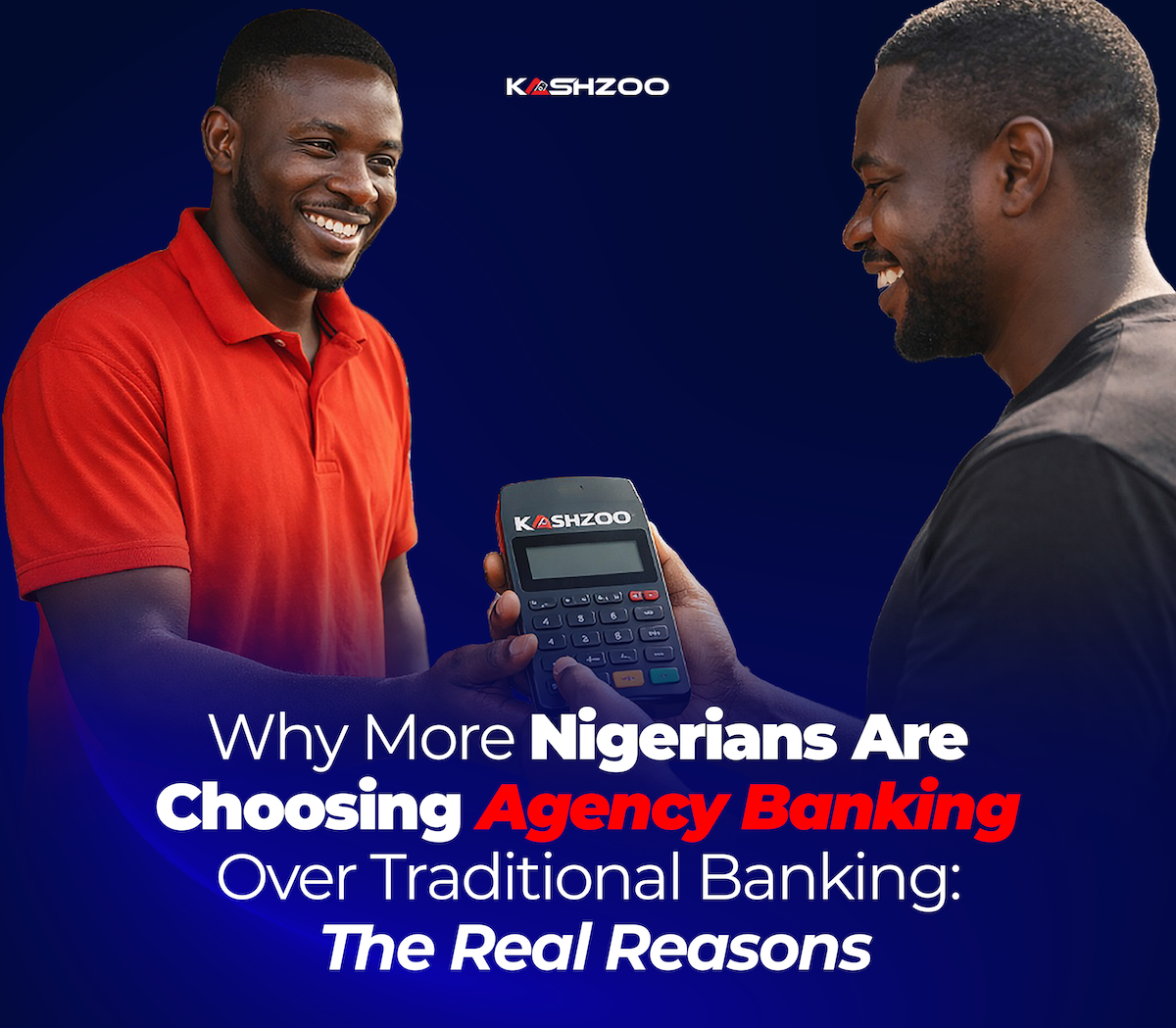



Walk down almost any street in Nigeria today, and you’ll spot a small kiosk with a POS machine, an umbrella, and someone shouting “POS!” to passers-by. That’s agency banking in action, and it has become one of the country’s most powerful financial tools.
For millions of Nigerians, the nearest “bank” isn’t a building with security guards. It’s a shop owner, a phone accessory seller, or a young entrepreneur with a POS terminal on a plastic table. And more people choose this over the traditional banking hall every day.
So what’s really behind this shift? Let’s break down the numbers, the reasons and what it means if you’re running a business in Nigeria right now.
What Agency Banking Actually Means for Everyday Nigerians
Agency banking is a model that lets banks and fintech companies partner with local shop owners and small entrepreneurs, known as agents, to offer basic financial services outside the traditional banking hall. Customers can withdraw cash, make deposits, send money, pay bills, and even open accounts, all through an agent, without ever stepping foot inside a bank branch.
This model has exploded in scale. Nigeria now has well over 2 million active POS agents, according to industry reports, spread across cities, towns, and rural communities that traditional banks have historically overlooked. Terminal deployment alone more than doubled in 2024, following the naira redesign, with roughly three million new terminals added in that single year.
There are now more places to access basic banking services through an agent than through an actual bank branch anywhere in Nigeria. That alone tells you why so many Nigerians have made agency banking their first choice.
The Real Reasons Nigerians Are Choosing Agents Over Bank Branches
The reasons aren’t abstract trends but real. Below are some tangible reasons;
- Banks simply aren’t everywhere agents are
Building and running a bank branch is expensive. Between rent, staffing, electricity, and security, many banks have concentrated their branches in major cities, leaving huge gaps in rural areas and even some parts of smaller towns. Agents fill that gap at a fraction of the cost, which is exactly why the Central Bank of Nigeria backed initiatives like the Shared Agent Network Expansion Facility (SANEF) to push agency banking into underserved communities.
- No queues, no “network is down” excuses (most of the time)
Anyone who has stood in a bank queue for an hour, only to be told the system is “temporarily unavailable,” understands the appeal of walking up to a POS agent and getting served in two minutes. Agents operate flexibly, often beyond regular banking hours, including weekends, something traditional branches rarely offer.
- The cash scarcity crisis changed everything
The 2023 naira redesign policy and the resulting cash shortage pushed agency banking from “convenient option” to “essential lifeline” almost overnight. With ATMs running dry and banking halls overwhelmed, POS agents became the most reliable way for many Nigerians to access cash. That habit has stuck. Even as ATM networks have started to recover in 2026, agents remain deeply embedded in how people manage everyday cash needs, particularly because of their neighbourhood presence and flexible hours.
- Agents offer more services than people expect.
What started as basic cash withdrawal has grown into a broader service window: bill payments, airtime and data purchases, money transfers, and even account opening. Agents essentially became mini-branches doing much of what a full banking hall does, minus the paperwork and long wait times.
- Trust built through familiarity.
There’s something powerful about doing business with someone in your own community rather than a faceless institution. Many Nigerians know their local POS agent by name. That personal relationship builds trust that a distant bank branch, staffed by people who change roles every few years, struggles to replicate.
- It created real income opportunities.
Agency banking helped customers and also became a genuine business model. Many agents report earning tens of thousands of naira monthly from transaction commissions. In Nigeria, agency banking has now become a popular side hustle and, for some, a full-time livelihood. This has fuelled its rapid, organic spread into virtually every neighbourhood.
The Challenges That Come With the Growth
Like any fast-growing sector, agency banking comes with real pain points, and as an agent, you should know them.
Rising fraud risks: As transaction volumes have grown, so has fraud targeting agents and their customers. Fraud tactics include social engineering scams and fraudulent reversal claims. Small agents often lack the advanced fraud detection tools that big banks have, making this an area worth watching closely if you’re into the POS business.
Fees can add up: Agents charge commissions for their services, and in areas with limited banking access, some fees can be steep. It’s worth comparing a few agents nearby rather than assuming they all charge the same.
Liquidity issues still happen: Agents sometimes run out of cash, especially during high-demand periods like salary weeks or festive seasons. This can leave customers stranded, particularly in areas where the agent is the only nearby option.
Regulatory tightening is underway: The government has moved to formally register POS agents with the Corporate Affairs Commission, partly in response to fraud concerns. This is generally a good thing for the sector’s long-term credibility, but it means the “anyone can become an agent overnight” era is gradually giving way to more structure and accountability.
What This Means for POS Agents and Business
The shift goes far beyond customer convenience; it’s a strategic advantage for agents and business owners;
- Consider becoming an agent yourself, if it fits your business: If you already run a shop, adding POS business can be a smart way to bring in extra foot traffic and additional income, especially if you’re located in an area with limited bank access.
- Use agents strategically for your own business transactions: For quick cash deposits or transfers when bank branches are inconvenient, a trusted local agent can save you real time, especially outside standard banking hours.
- Don’t rely on just one cashflow channel: Given the liquidity and network issues that still affect the sector, it’s smart to have more than one option for cash access or transfer
- Watch how the sector formalises: As registration and regulation increase, expect agency banking to become more standardised, possibly with better fraud protection and more consistent service quality. Staying ahead of these changes can help you choose more reliable partners as the space matures.
Final Thoughts
Agency banking solved a real, practical problem and became popular in Nigeria. When the traditional banks simply were not reachable, fast, or flexible enough for the way most Nigerians live and do business, agency banking stepped in and things have never remained the same..
Many years have passed and it is clear that agency banking is a clever fixture in Nigeria’s financial landscape. Understanding how it works and how to use it wisely puts you a step ahead in an economy that’s moving further away from banking halls and closer to the neighbourhood agent down the road.

What do you think?
It is nice to know your opinion. Leave a comment.